Thursday, June 21, 2012

Bind-O-Rama 2011 - Artistically Reversible: Where Conservation and Art Meet

Welcome to the 2011 Bonefolder Bind-O-Rama that demonstrates the intersection of conservation and the art of the book. We challenge binders and conservators to think about their work in different ways and to create compelling new work that applies “non-destructive and completely reversible book structures.” Since 2003, the Tomorrow’s Past movement (See The Bonefolder, Vol. 7, 2011) has led the way with work that demonstrates a high regard for the integrity of the original object, the application of current conservation best practices, and an innovative interpretation of book structure and aesthetics resulting in work that is lasting and fresh.

The integrity of the original is a key value of this movement, and stresses that books are not rebound or interpreted simply for the sake of doing so. Books of significance as artifacts with key elements of the binding in treatable condition or requiring simpler treatments are not appropriate candidates for this kind of treatment. Suitable books would be those that may have boards or other elements missing, have been previously repaired/rebound and showing the negative effects of those treatments, or whose original structures may have caused the breakdown of the binding in the first place. All treatments completed for this Bind-O-Rama must conform to current best practices in conservation, be reversible, and ultimately “do no harm.” This is NOT an altered book event. In contrast to past Bind-O-Ramas this event will be juried by the members of The Bonefolder’s board who are themselves trained conservators and active in the field. Kathy Abbott, a member of the Tomorrow’s Past movement will also participate as juror.

For ideas and more context please see the article in The Bonefolder, Vol 7, by Charles Gledhill, the Tomorrow's Past web pages, and this post at the Riverlark blog entitled Old wine in new bottles.

Additional examples can be found by Suzy Morgan, Gaylord Intern in the Conservation Lab at Syracuse University Library. In her posts she discusses the book she treated and some of the "ethical" questions. Take a look at these links: http://digitalcellulose.wordpress.com/2011/08/16/internship-report-month-1-part-2-now-with-more-coffee/ and http://www.flickr.com/photos/suzypictures/sets/72157627145298417.

Another example is the work of James Reid-Cunningham, conservator at the Boston Athenaeum. His treatment is at http://www.reid-cunningham.com/Design%20Bindings/insectarchitectu.html.

Karen Hanmer's example is at http://www.karenhanmer.com/gallery/piece.php?gallery=newwork&p=Walter_Crane.


To participate, please select the book you will treat/rebind carefully, keeping at the forefront the needs of book and your skills as a binder and/or conservator. Each entry must include:
  • Images: At least two, no more than 5 images of treatment including before, in-process, and completed. 
    • Specifications: Minimum 640 x 480 pixels @ 72dpi, jpg file format of your book. Files must be named as binder's name-1.jpg... (e.g. verheyen-1.jpg, verheyen-2.jpg) 
      • Examples below provided by Kathy Abbott.
  • Condition Report: please follow structure/syntax of example provided.
    • E.g.: Samuel Butler, Hudibras (London 1817). Bound in full leather; front board and parts of spine missing; text block sound with marbled edges.

      Hudibras (before, front board missing)
      Hudibras (before, front board missing)
      In process
  • Treatment Report: Includes statement of why the illustrated treatment was selected, description of selected structure, and aesthetics (please follow structure/syntax of example provided)
    • E.g.: Adapted ‘simplified binding’. Original sewing retained; spine lined with linen and hand-made paper; new endpapers of plain hand-made paper (to match the original); decorated, hand-made paper spine and hand-coloured, hand-made paper over hand-made paper pasteboards. 133 x 77 x 24mm. Bound in 2010.

      Hudibras (completed)
  • Brief Bio Sketch: of that includes training in binding/conservation (no more than 250 words)
    • Kathy Abbott served a four-year apprenticeship in bookbinding and then gained an HND from the London College of Printing, followed by a BA (Hons) from Roehampton University . She is currently self-employed as a bookbinder and book conservator and is a partner of Benchmark bindery, set up in 2009 with Tracey Rowledge. Kathy teaches bookbinding at the City Literary Institute and West Dean College and conducts many workshops across the UK. She has been exhibiting with the group Tomorrow's Past. since its formation in 2003.
  • Brief Treatment Statement: How this treatment approach impacts you and your work. (no more than 100 words)
    •  I create new structures which are sensitive to the needs of antiquarian books. They use little or no adhesive and are fully reversible. The inspiration for the colours used in the covers comes from those found on or within the original text-block.
All Images must be sent to <bonefolder@philobiblon.com> at the time the entry form is submitted.

Actual online entry form will be added here during the summer.

Deadline for entries Oct 31, 2011.

Monday, June 18, 2012

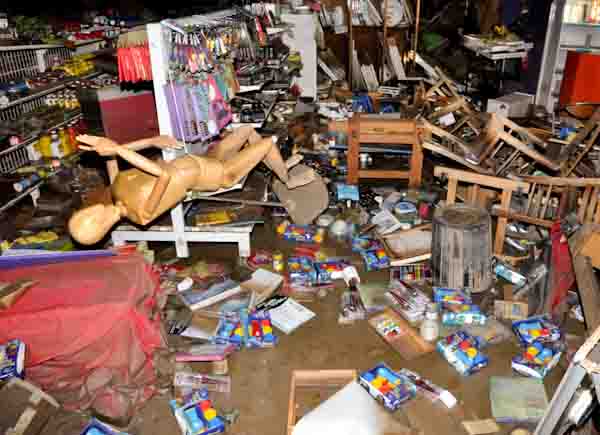
Floods in Queensland, Australia - From Adele Outteridge

We are all very relieved that the Artists' Books Collection at the State Library of Queensland is safe and look forward to the its reopening.


The Studio West End (Wim de Vos and Adele Outteridge) is dry and back to business. The water came to the front gate of the old ice cream factory site where we are housed. Not so lucky were so many other residents and businesses in West End, CBD and suburbs of Brisbane. The devastation and heartbreak are hard to comprehend.

I was marooned at home with our street flooded in both directions from Moggill Creek. We had no power for five days so were spared the harrowing images that saturated all television channels. The water came into one lower room but not the main part of our house. We have a few wet books and some old stored stuff. We were very lucky compared with neighbours whose houses went under.

Below some photos I sent to Peter for the Bonefolder Extras blog.

West End, the Art Shed

West End, the Art Shed

West End, mud

West End, Melbourne St.
South Brisbane, more mud
Kenmore, raining again
Kenmore, young Tawny Frogmouth
West End, before the storm
Cyclone Yasi.

Thanks to all who have sent messages of support.

Adele Outteridge

Adele Outteridge Wim de Vos
Studio West End
http://www.studiowestend.com

Tuesday, June 12, 2012

Index to The Bonefolder, Volumes 1 - 7, 2004 - 2011 now online

An index to Volumes 1 - 7, 2004 - 2011 is now online at the main Bonefolder website.The index is due to the efforts of Samantha Quell, longtime Bonefolder reader and currently a student in the MLS program at the State University of New York at Buffalo.Thank you Samanatha!


Click cover to read.

Saturday, June 9, 2012

Sheryl Oring on ABC’s World News Tonight with Peter Jennings

This article first appeared in The Bonefolder, Volume 7, 2011.

In Miriam Schaer's article, Capturing the Quotidian: Book Artists Explore New Tools – Performance, Travel and Story Collecting – to Reveal a Community’s Character, she featured the work of Sheryl Oring and her I Wish to Say project.

As part of that project "Oring conducted her first session in Oakland, California, with support from The First Amendment Project. People lined up around the block, waiting their turn. Afterward, she crisscrossed the country, setting up her desk, among other venues, in a laundromat in Tuba City, Arizona; a park along Los Angeles’ Skid Row; on the Las Vegas Strip; in public squares and college campuses; and at several locations in Boston and New York City during 2004’s Democratic and Republican presidential conventions. During the latter, the late Peter Jennings, then anchor of ABC’s World News Tonight, named Oring a Person of the Week, focusing a rare national spotlight on an artist book project."

Enjoy that clip via YouTube below.

Friday, June 8, 2012

The Beauty of Books

BBC4 began airing a 4 part documentary on Monday 7 February 2011 titled "The Beauty of Books" Although not available yet in the US (fingers crossed it will air soon on BBC America), the BBC has posted a YouTube video clip on the Codex Sinaticus.

The British Library (the featured institution in this documentary) has also posted a description of the program on their Medieval and Earlier Manuscripts blog giving a description of the first episode on Ancient Bibles with a link to the trailer.

Watch for this program to air on BBC America or PBS this year! When The Bonefolder hears when it will air, we will be sure to share that news with all of you!

Monday, May 7, 2012

Jan Sobota (1939 - 2012)

I first encountered Jan's work in Lewis' Fine Bookbinding in the Twentieth Century and was smitten. Then in 1989 I had the pleasure of taking a workshop on building 3-D/Relief designs when they were all living along the lake near Cleveland. Later I worked with him on 50x25, a wonderful exhibit featuring books by the Rarach Press.

He was a bear of a man with a heart of gold (and then some). His passing will leave a huge void.

Below included in Ladislav Hanka's moving celebration of Jan's life is a picture of Jan I took during that 1989 workshop.

Peter D. Verheyen


Obituary: in memory of Jan Sobota
Written by Ladislav R. Hanka, Kalamazoo MI


Jan Bohuslav Sobota passed away the 2nd of May, 2012. An active member of the Guild of Book Workers since the early-1980s, he was my friend of thirty-three years, binder of my books and co-exhibitor on two continents. I feel called to share some reflections on his life with the many of you who knew him, were his students or just admired his work:

Jan came to the USA in 1984, sponsored by the Rowfant Club of book collectors in Cleveland. He‘d been in Switzerland, exiled from his native Czechoslovakia and was employed at the conservation lab of Case Western Reserve University, eventually going to the Bridwell Library at Southern Methodist University in Dallas. Conservation work paid the bills, but you, his friends and colleagues, all know that his first love was the making of fine unique design bindings. He arrived during the renaissance of American book arts in the 1980’s and hit the ground running as an active promoter and sponsor of shows and workshops. Jan Sobota was a tsunami of the book arts, affecting all around him. With his wife Jarmila, they immediately established the Saturday’s Book Arts Gallery in Euclid, Ohio and kept the name and concept of that gallery alive in various places and incarnations as they moved about the world. (Sobota means Saturday in Czech). Day jobs at universities gave Jan financial stability and institutional support, but also multiplied the effect of his book arts efforts, allowing him to better apply the benefits of his coming from an unbroken tradition of apprenticeships and bring a profound knowledge of the craft and tradition of bookbinding to the many American students eager to learn at a time when that knowledge was being lost at a staggering rate. He shared that knowledge generously with anybody who would listen.

Jan survived both Nazis and Communists, yet that adversity didn’t embitter him. He was kind and circumspect in how he spoke, but also no fool. He was an astute observer and his short experience of America contained contrasts that speak volumes. America gave him opportunity and he repaid the favor manifold. He believed in the USA as a nation of principle, based in a humane constitution (which he studied) and the rule of law, but he was not a mindless patriot or an unqualified believer in free and unregulated enterprise.

Early on in Cleveland, Jan contracted cancer, before he could afford health insurance. He survived and came to understand America as a society where neighbors help each other. People they hardly knew, appeared with casseroles, left meat loaves on the porch, lent them money and took up collections. They were a Godsend, but he also discovered that America’s pioneer spirit not-with-standing, kind neighbors couldn’t stop his family from slipping into a psychic debtor's prison over his health crisis. Now comes the Sobota story I most love telling: Jan had staggering debt, a colostomy and a family to support. He took on more conservation work, among which was an old book, with crumbling boards. Inside the leather covers Jan found an odd mass of stuck-together papers, which he soaked and carefully teased apart. These scraps turned out to be a deck of medieval playing cards - the second oldest such cards known. He restored them and sold them for enough to cover his medical expenses. Few people would have cast that glued-up mess a second glance before pitching it, nor would they recognize what they had in hand or known how to restore or sell it. God helps those who help themselves – no?

Even after the debt was retired, money was still an issue for a family of immigrants with three children, (two of them with special needs) and limited use of English. At one point the Sobotas responded to the seductions of Amway. They stayed with us in Kalamazoo, while taking the “introductory course” nearby. Day by day they became indoctrinated and groomed to invade their home in Czechia with cleaning products and a new pyramid scheme. They left in a get-rich-quick haze, but in a week their freshly laundered brains began to awaken. Jan, the survivor and master filter of propaganda and Jarmila the psychologist had been thoroughly buffaloed. They bashfully admitted their foolishness and went back to the real work of making beautiful books in Texas.

Soon afterwards, the massacre at Waco opened Jan’s eyes to yet another difficult side of his adopted home. That smallish incident within the parade of American fringe politics and its insanely violent suppression left a far larger mark on Jan than one might expect. He’d seen far worse, but he didn’t expect it of the US. American society was becoming a lot more complex in its high and low points. He was really getting to know us at our best and worst.

In 1996 the Sobotas re-emigrated back home to the Czech Republic – quite suddenly actually. Life in America had been good and they’d developed an extensive social and professional network, but it was still a foreign country. Then one day in Prague, when it came time to put an end to vacation and board the plane for Dallas, they just couldn’t do it. The need to be home was overwhelming – a physiological necessity. Jarmila stayed and Jan went to pack up their belongings and make a new start, once again. It was however a good choice and they became very engaged in the Czech Society of Book Workers. Jan became active in municipal and local politics in matters related to small-businesses and craftsmen – the local engines of every hometown economy that make real things which actual people need, paying taxes and creating a civil society, regardless of what the big corporations and big governments might claim to be up to. It isn’t just a matter of Jan’s politics, but a picture of who he was and why he made the books he did. He was an integrated whole person and it was all about having his feet on the ground, his hands calloused, dirty and in the material world and being face to face with actual people in honest exchanges. Whether just re-binding a family Bible, repairing some children’s books with folk tales or conserving a rare medieval incunabulum or even binding brand new books made by his friend in Kalamazoo – it was all honorable work and for the good.

There are many lives that Jan has touched, but I can speak best of my own experience. Many of you will remember the 1995 book show in Dallas, in which 25 invited guild members participated and bound my books. Jan had a generous catalog published; the show was then circulated and eventually sold into a public collection. That resulted in my first brush with financial security. A decade later we did a similar show together, which was exhibited at the National Museum in Prague and then Pilsen. These events don’t happen accidentally. They are orchestrated over years. They are rare. They are major inflections in the life of an artist. I owe a great debt of gratitude to Jan, but I am hardly the only one.

Jan died in his sleep – just closed up shop one evening and went to bed for the last time, leaving behind piles of books in various stages of completion. The night he died, I got up at 3 AM to collate and package a new book to send him – presuming that Jan being Jan, he would jump at more work. Retirement is after all for sissies. His feet may hurt; his blood sugar levels may be sky high; major pieces of his plumbing may have gone AWOL; but he’s only 73! It’s Jan here - the indefatigable boundless font of energy – Jan Sobota! I was also composing a colophon in which I mentioned him and how important the living links to traditional handcrafts are, when I began noticing that; of the paper-makers, binders, lithographers, tanners, typesetters and printmakers I was acknowledging, most were dead - perhaps noticed it as Jan himself was passing from this earthly plane.

The old ways pass and we who maintain vestiges of that knowledge carry a large burden in the shadow of mass-produced consumer culture. We are the guardians of that which cannot be falsified or mass-produced. What we do carries the impress of human hands and communicates the loving care with which it was made. It has far more to do with your grandmother’s cookies than any industrial product. The products of this handwork are like the tools in Jan’s shop, worn and covered with the marks of honor that years of continual use inevitably bring. Tools are to be used. Cookies are to be eaten. Books are to be read.

Jan was among those guardians of the human patrimony who gave others the courage to stay the course. Our fellow citizens will eventually want that which we care-take and we must keep it alive until they realize they need it. Jan breathed a lot of life back into his calling – gave back at least what he was given by making that moral choice to be loyal to his aesthetic values. He’d save an old bindery from the scrap and antique dealers in order to redistribute the tools among those who’d honor the masters by using them – by cutting down the shaft of a burin to fit the unique needs of one’s own hand, perhaps re-temper the steel to better cut contemporary materials.

Jan and I began our binding collaborations with a series of Moravian folk tales collected by my grandfather – humorous tales about the activity of the Devil in the lives of simple villagers in the sticks – something like a Czech version of the Devil and Daniel Webster. It is deceptive material and contains a great deal of wisdom, informed by generations of inherited shared experience; the universal consciousness reflected in folkways. To illustrate it oneself and then to print it by hand in Czech and bind it in full leather with a nice slipcase is hardly a savvy business decision and yet I find it hard to imagine a more fitting thing to inherit and value beyond all money. Things made with that level of integrity are a joy to hold and to use.

It is the role of age to be reflective as friends and colleagues wink out one by one - to reflect on the meaning of death. What values from the past is it worth maintaining and which battle is no more than a pointless struggle against an unstoppable rising tide? I don't feel very adequate to the role of guardian of the values and skills of the past and yet I suppose I am becoming the living expert in some aspects of a few of these arcane skills. In this I’ll take my example from Jan Sobota by being a living breathing example and simply do what I do well, each piece warm and worn from the touch of my hand before I release it to the world and pass it on over to another.

Jan Sobota’s death is a meaningful punctuation point, because his life was lived meaningfully. He made modest art of human dimensions calling to be touched – exceptionally crafted and informed by a lifetime of profoundly humanistic experience. With each such death the baton is passed once more to the gimpy and crippled to run the rest of the race for those who no longer can.

Vladimír Škutin, Marie Jose Sacre, ill., Kde Bydlí Cas (Where Time Lives), 1985
From the Guild of Book Workers' 100th anniversary exhibit held in 2006.

Rest easy my friend.


Remembered I had this image of me in my youth with one of Jan's bindings.

    Tuesday, February 21, 2012

    The Concave Spine and Bill Anthony

    This is being reposted from the Book_Arts-L listserv at <https://listserv.syr.edu/scripts/wa.exe?A2=BOOK_ARTS-L;5c8db0f0.1202> due to the strong interest in this structure and questions about its history. The concave spine discussion can be followed at <https://listserv.syr.edu/scripts/wa.exe?A1=ind1202&L=BOOK_ARTS-L#34>.

    Friends and Colleagues,

     In 1971, Bill Anthony and I produced an experimental binding with a reverse-round, now known as the "concave spine". Our example of this interesting binding structure had been lost for many years following Bill's untimely death in 1989. The book was recently found and is again part of the Univ. of Iowa's important collection of bookbinding models (see below). Gary Frost, conservator emeritus pointed out this special binding during my recent visit to the campus.

    The reverse round / concave spine binding was made in 1971 shortly after Bill had seen the famous BOOK OF KELLS during his trip back home. Bill described how that important Irish manuscript had been rebound by Roger Powell and that when the book is being exhibited at Trinity College Dublin, the spine is supported with a wooden dowel. I recall that Bill and I discussed "why do we bind books with a convex spine, when the structure will undoubtedly reverse to a concave spine when opened". To help answer that question, we bound a book with a reverse-round.

     I was glad to see that binding again after all these years. One can easily understand that there is no movement of the spine, yet the pages open freely. In recent years other binders have experimented with this unique idea, the concave spine.

     Historical Models at the University of Iowa: While Bill was the book conservator at the University of Iowa in the 1980's, he and his students produced numerous examples of early bindings as well as a few experimental bindings. Over the years more bindings have been added to this important collection. Pictures of those bindings are available at the following website: http://digital.lib.uiowa.edu/binding/index.php

    "Treatment Report" -- sheet from 1971 detailing the "Reverse (Concave) Spine" binding: note that contact cement was used to secure vellum to the sides of the covers.


    Two pieces of wood were used to make the "normal" spine.


    Opening with minimal strain, actually no strain, to the binding structure.


    Bill Minter
    Originally posted to Book_Arts-L at  ><https://listserv.syr.edu/scripts/wa.exe?A2=BOOK_ARTS-L;5c8db0f0.1202>.

    Addendum [Posted 3/11/2012]

    Bookbinding Colleagues,
    A few weeks ago, I shared some information about an unusual, reverse-round binding that had been lost and was recently found. Upon looking in my files, I found some further details that may be of interest, especially regarding the swelling from the sewing:

    Binding a Book with a Reverse-Round, aka Concave Spine

    In the early 1970s, during my apprenticeship with Bill Anthony, he was telling me about the BOOK OF KELLS, an 8th century Irish manuscript that he had seen during a visit to his homeland. Roger Powell had restored that great Irish national treasure in the 1950s. When this book is exhibited to show the magnificent illuminations, a wooden dowel is inserted under the spine to support the sewing. Bill went on to describe the stress that a binding encounters as a book is opened and how the spine moves from a convex shape to the concave. Then there was the inevitable question:   "Why do we force a book to do that?" He further explained the swelling that is created by the sewing thread, and how we, obviously, manage that swelling by rounding a book with the convex shape. We wondered what would happen if the book were bound with the concave-shape "built-in". Obviously, the concave shape is readily seen on many well-used, flat-spine books, such as thick telephone books.

    In order to learn more, we prepared an old discarded textblock by sewing it on linen tapes. After gluing up the spine, we reversed the round to accommodate the swelling, thus producing a concave spine. Since we were thinking that the book should look "normal", we prepared a piece of wood --- #1 pine (without knots) from the local carpenter, as I recall -- to fit the concave shape; the linen tapes were then wrapped around the wood. Then another piece of wood was shaped for a normal spine, but this wood was wider to allow a normal shoulder to accommodate the boards. The binding was quarter-leather with vellum sides --- note here we experimented further by attaching the vellum with contact cement which is certainly not a standard bookbinder's adhesive. The true beauty of the binding was obvious upon opening. The book functioned magnificently with no stress or strain while the pages opened fairly flat and the gutter margin was easily viewed. The binding verged on being absolutely perfect and a dream to behold.

    Sadly, Bill died on February 8, 1989. This one and only "reverse-round" binding was then thought to be lost because it was not in Bill's binding collection. Only recently was the book found and it is again part of Bill's collection of historic binding structures now available at the University of Iowa. These and many more historic bindings can be viewed at the University of Iowa website:   http://digital.lib.uiowa.edu/binding/index.php

    As we know, James Brockman has furthered the development of this interesting and unique structure --- a brief description is available at    http://www.hewit.com/skin_deep/?volume=2&article=1#article. The concave spine binding is a structure that deserves further investigation for that special book or perhaps for all books, if that were possible.

    Bill Minter